

Featured article

If you work with ads, repeat this until it sticks:
Ad monetization is a core product experience.
Even in 2026, ads still often receive less energy, care, and investment than other product features. That’s the unfortunate truth.
Another truth is that ads are icky. Putting aside the actual ickiness of questionable ad quality, a lot of people just don’t like them. Mention ad monetization at an industry conference and you can often see the light in people’s eyes go dim.
Many product and game-design teams share that discomfort, no matter how much revenue they make from ads.
Some of that dislike is visceral, and some of it is rooted in legitimate concerns about retention, engagement, and IAP revenue. But legitimate caution often turns into poor execution. Teams are afraid to make ads too prominent, afraid to offer rewards players genuinely value, and unwilling to integrate ads too deeply into the game.
The result is predictable: weak engagement, awkward UX, poor reward balance, and an ad system that never reaches its potential.
Fixing this comes down to two things: give players what they want and make it feel good
Give players what they want
Giving players what they want sounds simple, but rewarded placements usually fail in one of three ways:
Wrong value
Teams often build placements around what they feel comfortable giving away rather than what players actually want. That is how you end up offering a reward that’s too small, a resource the player already has too much of, or a generic reward that’s technically useful but not exciting.
If the amount is the issue, the solution may be relatively straightforward. But if players do not value the reward regardless of quantity, a deeper change is needed. Look at what players work toward, where they get stuck, and which resources they consistently run out of. That will tell you what they actually want.
Then give them that.
Wrong moment
The same reward can feel valuable in one moment and pointless in another.
A resource offered from the main menu may attract little interest. Offer it again just when the player has run out? Suddenly, it’s your top-performing placement.
Does your new event create a strong sink for a specific resource? Has the player failed against the same boss multiple times, where a small boost would make all the difference?
Find the moment where the player wants something, then build the placement around that need. Many placements are designed as permanent buttons instead of answers to specific player needs.
Wrong player
A new player and someone who has played for six months probably do not value the same resources. A payer and a non-payer may not react to the same offer in the same way. Someone who watches every rewarded ad available should probably not be treated the same as someone who has ignored the placement for weeks.
This does not mean you need a huge personalization system from day one. Even basic segmentation can make a big difference. One of the more common mistakes I see is that studios are not scaling rewards with player progression, or they aren’t scaling them enough.
Another mistake is not catering to your ad whales. If you have a $300 eCPM watcher, stop treating them like an average user. Their rewards and limits should reflect the value they bring. Give them a VIP experience.
Rewarded ad design is ultimately a matching problem: the right value, at the right moment, for the right player.
Make it feel good
Take any major title as an example. Do ads show the same amount of polish as the battle pass? In most games, the answer is a resounding no.
That gap in polish is exactly where you can create additional ad revenue while also improving the user experience.
Start with visibility. The rewarded button needs to POP. It should stand out through clear visual hierarchy, effective use of size and color, and animation where appropriate. And if the placement offers recurring, meaningful value, players should not have to search for it. I often have to fight for main-screen real estate, and that position can be all that stands between a mediocre placement and a great one.
Taking it further, the placement should also feel like a natural part of the game world. Free items in the shop can become a promotion from the shopkeeper. A revive can be presented as a goddess offering the player another chance.
The reward delivery should feel satisfying too, with the same attention to animation, sound, and feedback given to other valuable moments. Watching the ad may be external to the game, but everything before and after it does not have to feel that way.
Wording is part of that experience. Players should immediately understand both what they will receive and why it is useful. “Watch to receive 100 energy” explains the reward. “Refill your energy and continue the event” explains its value in that moment. Make it obvious.
Applying these principles can completely transform a placement without changing the reward at all.
I’ve repeatedly seen clearer wording and better visibility increase engagement. Sometimes the improvement is incremental; sometimes it’s dramatic. Either way, at scale, even a small lift can translate into meaningful revenue.
More importantly, those gains come from making the experience better rather than increasing ad pressure or giving away more value.
Theory is nice, but what happens in practice?
To give concrete examples, here is what happened when we applied these principles in two different games. While client confidentiality limits what I can share about the titles, the anonymized results still show how these changes affected player behavior and revenue.
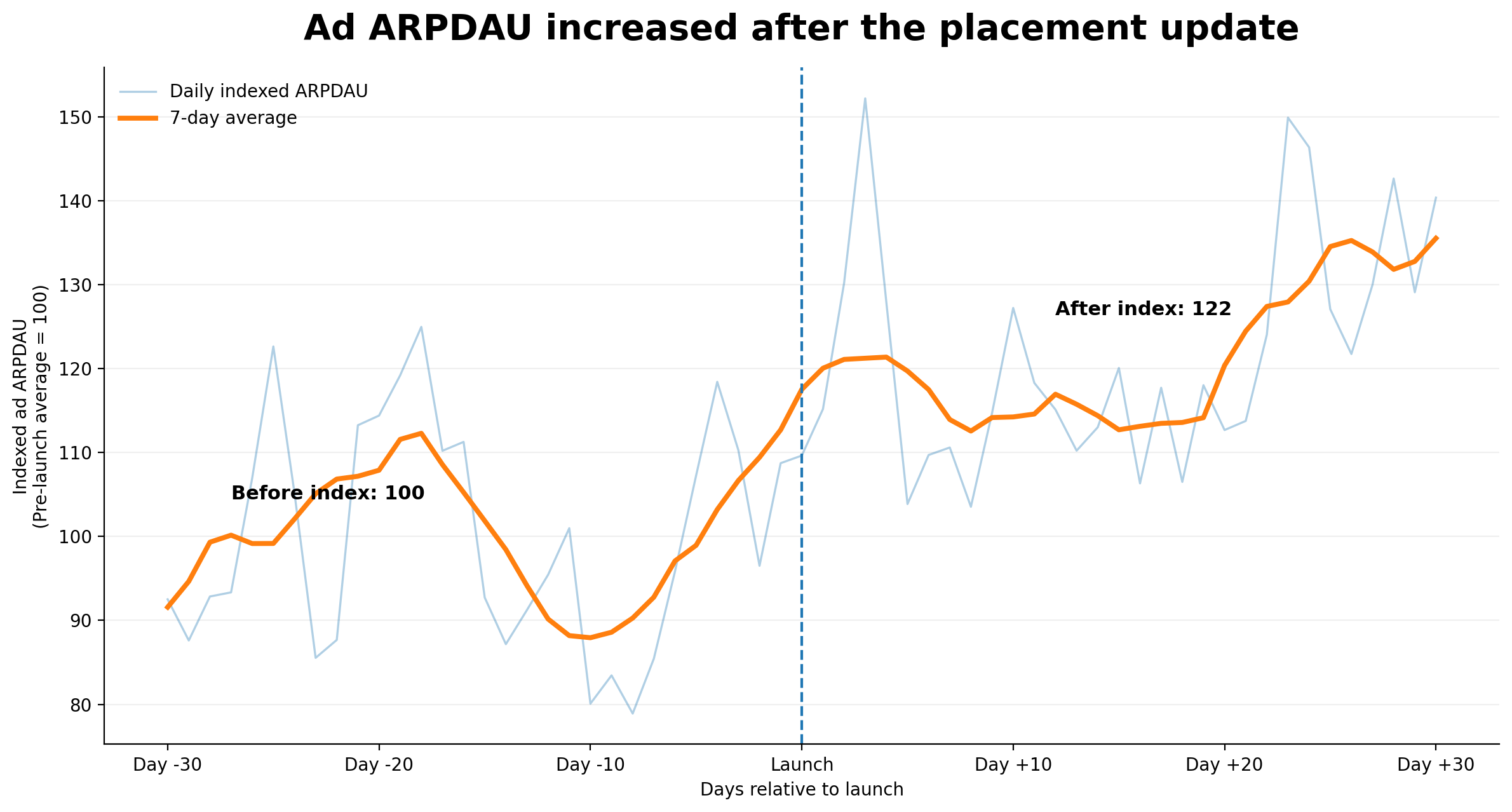
In one mid-core title, we added a placement that was better aligned with a specific player segment and gave the existing rewarded-ad experience a UI and visibility overhaul.
Over the following 30 days, the ad viewer rate increased from 35.8% to 39.9%, and impressions per DAU rose by 11.3%. Crucially, impressions per viewer stayed flat.
In other words, we did not generate growth by making existing viewers watch more. We generated it by convincing more players that the rewarded ads are worth engaging with. Those new viewers also delivered stronger eCPMs, further improving the performance. Taken all together, the overall rewarded video ARPDAU increased by 21.9%.
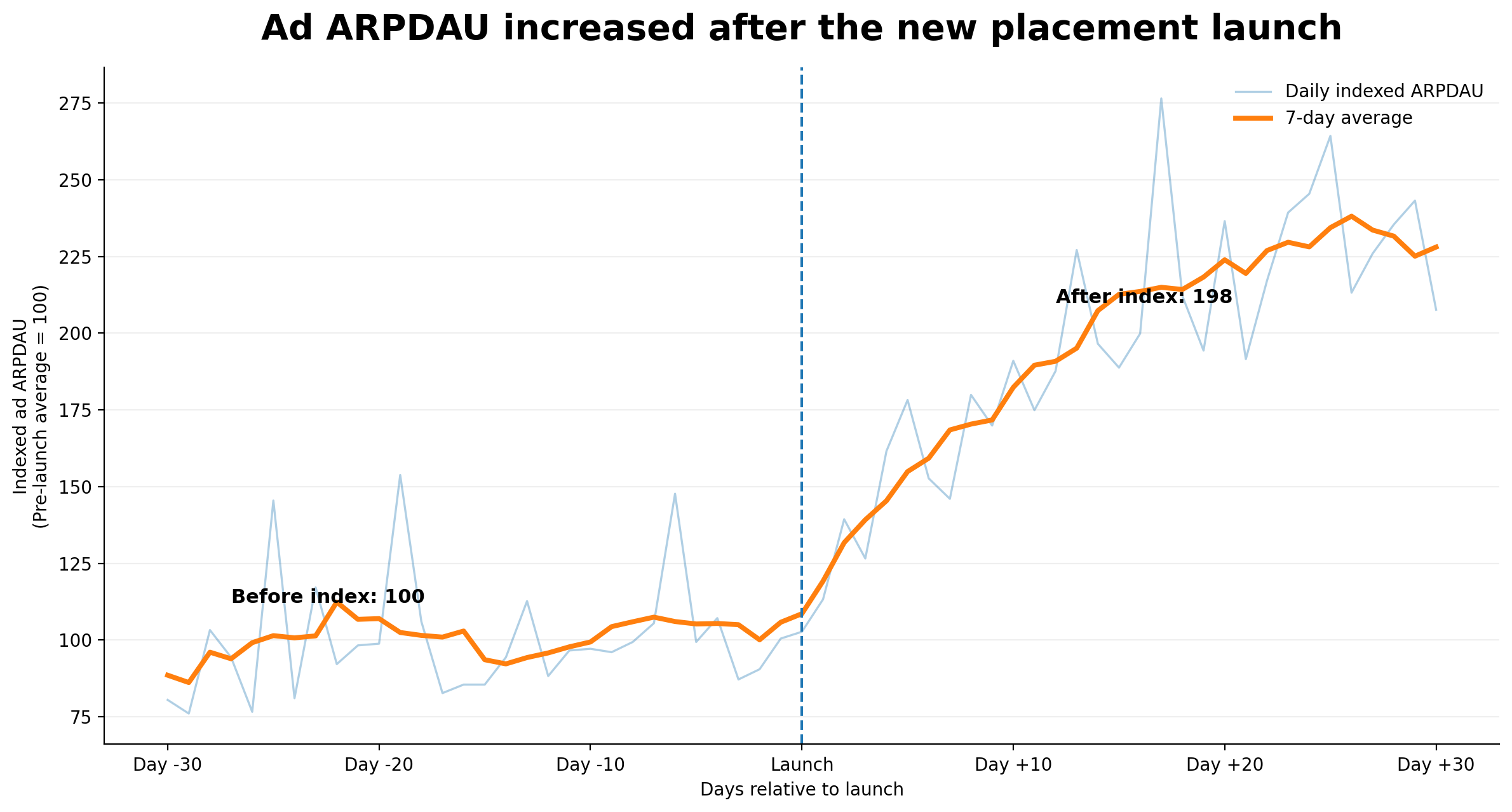
In another, more casual title, we added a rewarded placement built around a specific pain point: giving players a re-roll to reduce the frustration of randomness.
Over the following 30 days, impressions per ad viewer more than doubled, while impressions per DAU increased by 154%. All from one new placement.
The result was a 98% increase in rewarded video ARPDAU, and the best part is that we found no negative impact on IAP performance.
Build Something Worth Choosing
There is still a great deal of untapped potential in rewarded ads, and much of it does not require showing ads more often or giving away increasingly generous rewards.
It comes from better matching: the right value, at the right moment, for the right player. It comes from making placements visible, understandable, and satisfying to use. And it comes from giving ad monetization the same product attention already given to shops, events, battle passes, and other core systems.
And yet, when a rewarded placement underperforms, the easiest explanation is often that players do not like ads or that ads simply don’t work. Sometimes that is even true! But before reaching that conclusion, look closely at the experience you have actually given them.
Players will tell you what they value through their behavior. But you have to give them something worth choosing first.