



Featured article

Apple has four months to ship a new design of its App Tracking Transparency (ATT) framework, which originally launched back in 2021.
According to Reuters, Germany’s Federal Cartel Office found that Apple's App Tracking Transparency framework gave its own apps more favourable consent prompts than those of third-party developers, potentially breaching competition rules.
This is good news for app publishers, as well as some of the ad networks that never found their way around serving ads in the non-IDFA environment.
Here’s everything you need to know if you are a mobile app studio.
How it all started.
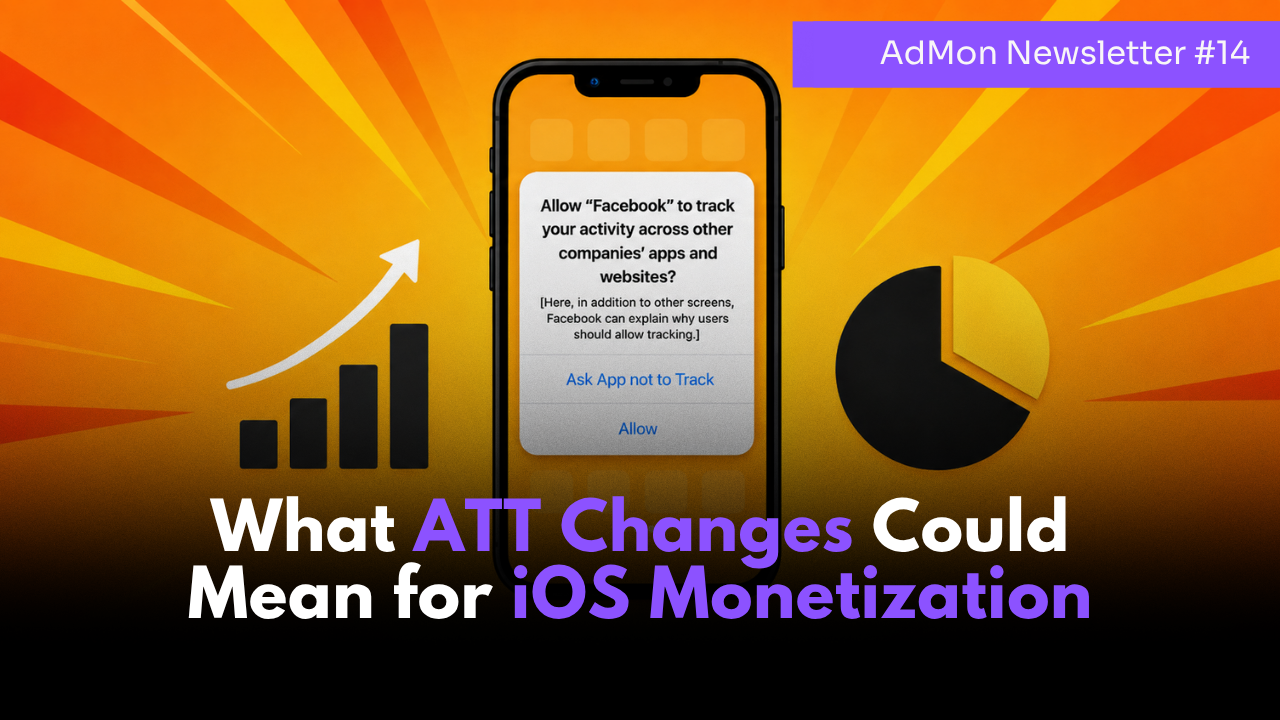
Since 2021, Apple has required all app publishers to prompt users with its ATT message in order to access IDFA (Identifier for Advertisers). If no message is shown, IDFA is zeroed out and the app publisher (and its partners) cannot access this valuable identifier. IDFA is a critical piece of information which was previously heavily used for ad targeting and personalization. The problem with the message was that it was intentionally designed to minimize the opt-in rate, with almost no option for customization (image below). In the beginning, Google and Meta refused to comply with their own universe of apps but eventually budged.
.png)
As a result, opt-in rates were very low for the majority of publishers, eCPM went down, user acquisition was impacted big time, and some networks, especially Google and Meta, had their performance plummeting almost instantly. Since then, these two networks have not been able to recover, especially Meta. Other networks such as Applovin started dominating the iOS platform.
The current IDFA vs. Non-IDFA impression distribution.
We analyzed data for January - July 2026. period across 15 different apps from the GameBiz portfolio of clients. Gaming and non-gaming, various genres, MAX and AdMob Pro mediations, all three major ad formats (rewarded video, interstitials and banners - no they are not dead).
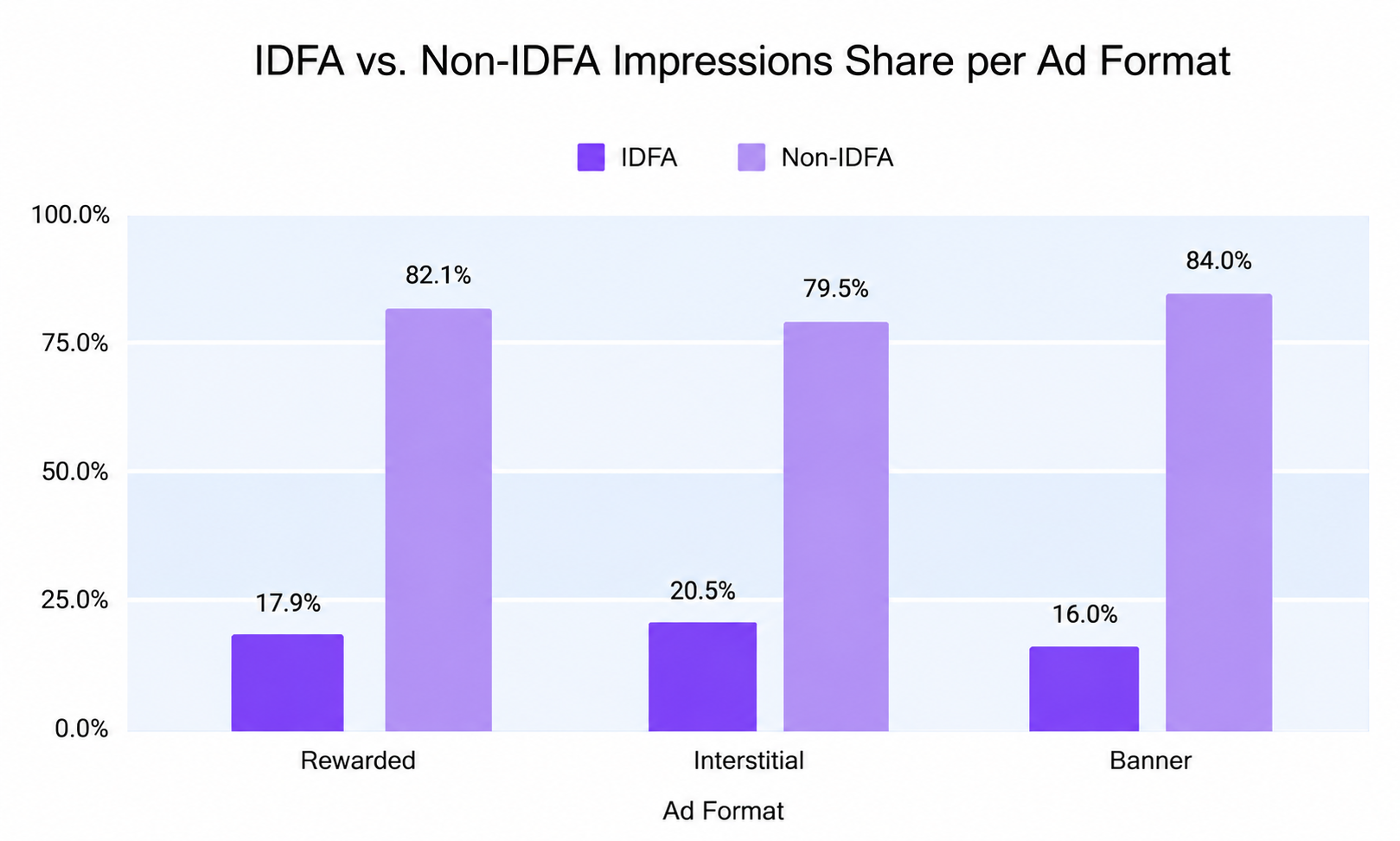
As we anticipated, the vast majority of impressions on all three ad formats are served without IDFA in place (~80%). See the chart below.
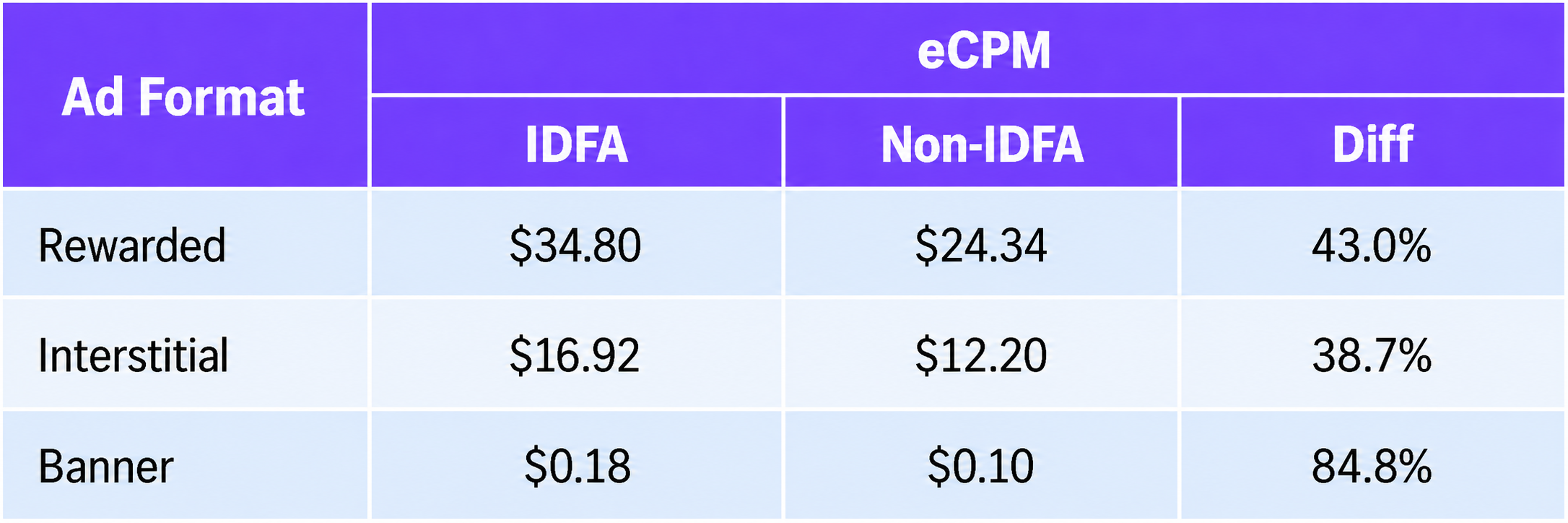
To demonstrate the reality the industry has been living in since 2021, compared to the period before, it’s best to include eCPM data per ad format and IDFA availability. You can see that eCPM of impressions with IDFA present is 40% - 80% higher, depending on the ad format. Remember the eCPM decline we all faced back when ATT got enforced?! 😅
Ad Networks and IDFA.
Looking at the data we have at the moment can give us a pretty good idea of how things might change after the expected changes in ATT design.
Google (AdMob) and Meta Audience Network show the highest dependency on IDFA. Take a look at what share of ad revenue and what share of impressions each network generates depending on which environment we are observing - IDFA or Non-IDFA. Also note the differences in eCPM for each ad network. We included data for the top 10 ad networks used in our portfolio, while the remaining networks are grouped under “Other”.
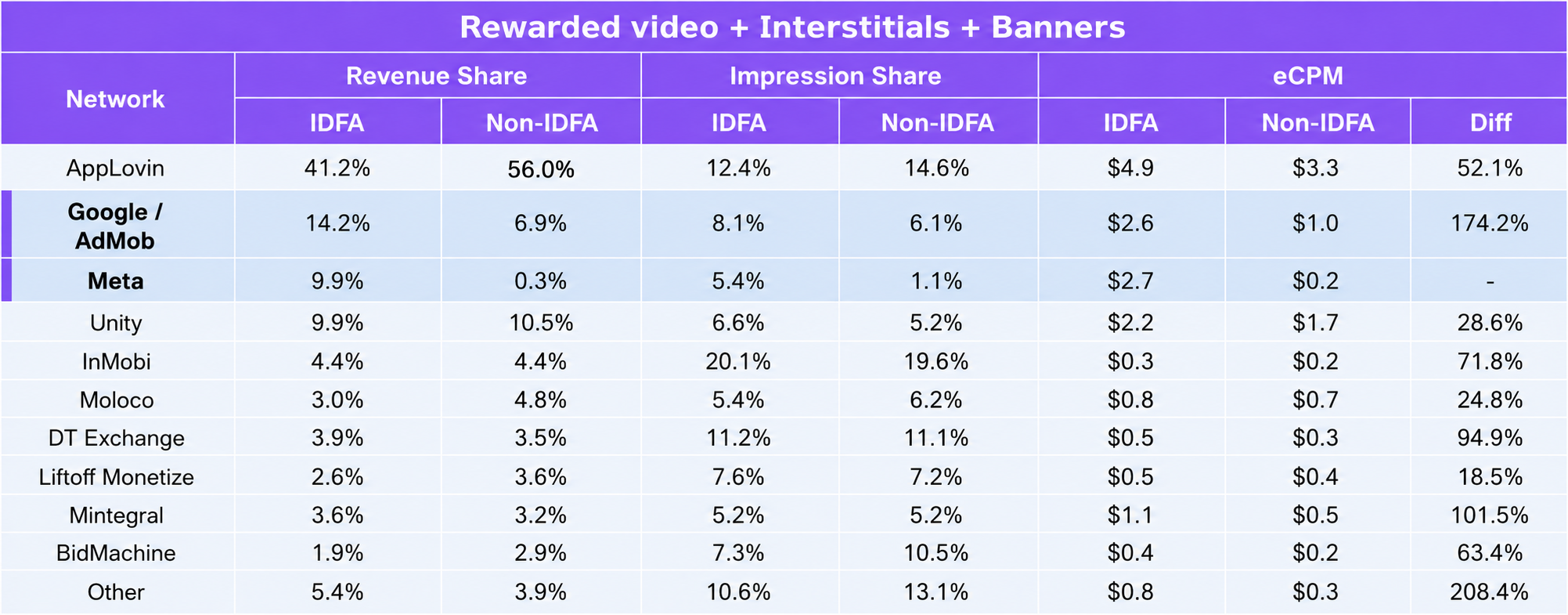
Even when we break it down per ad format, Google and Meta are the only networks showing strong dependency on IDFA regardless of the ad format. Mintegral joins them as the most dependent to IDFA on rewarded video format, InMobi on interstitials while on banners, Unity sits alongside Google and Meta.
On the other hand, Applovin shows consistently across all three ad formats that it can take a much higher share of revenue and impressions on non-IDFA traffic. Moloco shows similar (but less pronounced) behavior.
If you’re curious to see ad format specific data, feel free to check it out here.


