

Featured article

Earlier this week, the UK’s ASA issued a ruling against several mobile app companies, including notable names in the mobile games space, namely King and Scopely, as reported by gamesindustry.biz.
We took a close look at these rulings and contemplated a bit about the broader implications and the wider ad quality landscape.
What is ASA?
ASA stands for Advertising Standards Authority. They come from the UK and they are an independent, self-regulatory organization for advertising across all media in the United Kingdom. Their mission is to ensure that marketing communications in the UK are legal, decent, honest, and truthful.
Who ASA ruled against this week?
- King. Farm Heroes Saga game. Two Meta ads. One ad was ruled against while the other was ruled as non-violating, after the investigation. Full case.
- Scopely (Loom Games studio). Game Pixel Flow!. Two Meta ads. One ad was ruled against while the other was ruled as non-violating, after the investigation. Full case.
- Omnilojo Pte Ltd. Dark War Survival game. Three Google Ads. Full case.
- Royal Ark (Vistrex Ltd). Game Idle Zombie Miner: Gold Tycoon. A Meta ad and the listing on Google Play Store. Full case.
What are this week’s rulings about?
It appears that these rulings are the result of a wider investigation into misleading gameplay in ads for mobile games. All ads seem to have been caught on 28th April 2026.
The ASA namely points out this concern in regard to all of the ads above misleadingly giving the impression that they showed.
In each case, ASA explains in detail why each of the mentioned ads was investigated, what were the considerations, responses from studios, as well as their final ruling. Notable and interesting details from these cases are below.
- When it comes to King’s ads, two ads were investigated. One ended up with a verdict that it was misleading, the other was acquitted. What seems to have tipped the scales in King’s favor is the lack of cursor in the problematic part of the ad. In ASA’s words: The ad opened with an animated sequence showing the sun rising while fruit and vegetables were picked. Unlike the gameplay-style content in the other ad, the opening sequence did not feature a hand-shaped cursor interacting with a game board, a level objective, or other features indicating that consumers were being shown playable content. We considered consumers were therefore likely to understand that sequence as thematic or promotional material associated with the game’s farming theme, rather than as representative of gameplay.
- Scopely defended their ads, saying both ads featured a short, stylised introduction designed to introduce the game’s characters. Those introductions were not intended to be viewed as part of the game and What is their penalty? After the introduction, both ads featured real gameplay. The most interesting part for me was the argument about the duration of the problematic (potentially misleading) part of the ad. It seems they made a somewhat solid argument since one of the ads was found not to be in violation of ASA standards.
- Omnilojo case was interesting because ASA had one more issue with their ad. In the creative, it was shown “2026 Game Creative” and “2026 Survival Game”, which ASA interpreted as claims that the game had won official third-party awards. On the other hand, Omnilojo defended themselves by saying those phrases were intended to refer to the game having been featured and recommended in official rankings and promotional placements on Google Play and the Apple App Store. ASA did not believe the argument and has ruled against this ad.
- As for the Royal Ark, both their Facebook ad and the Google Play Store presence were found problematic.
What is their penalty?
There’s no penalty. ASA cannot issue penalties as they are not a government entity. They review ads and issue rulings, asking advertisers to comply and stop with bad practices. ASA claims that the vast majority of advertisers comply with their findings. Apart from public scrutiny on advertisers, the ASA can, if they found it necessary, also take their findings to the UK’s Trading Standards, who could then come up with their own ruling and sanctions.
Is this the first time mobile games companies were held accountable for the content of their ads?
No. Previously, there were several cases where ASA publicised its findings of advertising violations by gaming studios. Specifically:
- In March 2025, they did a thorough investigation about mobile ads that may be harmfully objectifying women. They found several studios in breach, including Brightika, which even failed to respond to ASA concerns, as well as Gamehaus Network Technology and others.
- Their investigation into sexist ads. It found Refantasia: Charm and Conquer, from Chinese studio Oasis Games, Legend City from developer TeamLOM and Kings Throne: Game of Conquest by GOAT company. All three complied and removed problematic ads. The case was closed in September 2022.
- Topics they investigated over the years included sexual and domestic violence (AppQuantum Publishing, OneSoft Studio, Brightika again), nudity and objectification (ABI Global, GOAT Company again), as well as Targeting, misleadingness and other rules (FunPlus Interactive, AppQuantum Publishing again and Playrix among the offenders)
ASA is in the UK only. What’s happening in other markets?
We managed to find a few other cases of organizations trying to regulate advertising practices of mobile games.
The Stichting Reclame Code (SRC) or Advertising Code Foundation from the Netherlands made two rulings against MY.GAMES - developer behind the Rush Royale game. Their main objection was that the game failed to mention the presence of loot boxes in its Meta ad (details here). This should be put into the context that the Netherlands was one of the most vocal European countries advocating against the very existence of loot boxes in video games.
Apart from them, Canada’s Ad Standards organization ruled a case back in 2024, against well known Vita Studios due to “unsupported performance claims”, specifically The ad featured a man claiming to be a neurologist promoting an app that was designed to help with memory loss and sleep deprivation. The ad also mentioned, “you’ll even look younger”.
Let’s put that into context.
According to SensorTower, the number of unique creatives has grown +54% in gaming YoY in August 2026. With AI being part of the creative production of virtually every studio, we are talking about millions of creatives that studios are running. Of course, campaigns are running in virtually all countries in the world, with a lot of budget being spent in all English-speaking territories, most importantly in the United States. So, even if we missed a few countries and a few cases in our research, the advertising market remains almost completely unregulated, leaving it up to studios' best judgment and intentions (look where that’s got us).
What's the big deal? It can’t be that bad, can it?
Oh, it certainly can and it certainly is.
In my ten years in mobile games, ads have never been more disruptive. Aside from all the aggressive practices from ad networks (120+ seconds for rewarded video, 30+ seconds for interstitials, deceptive UI practices, multiple steps to close the ad, auto redirects), advertisers themselves have posed a huge challenge to players as well as to publishers trying to retain those players. The (not so funny) part? More often than not, advertisers and publishers mentioned are the same companies. Meaning - everyone is feeding bad ads into someone else’s games and it’s a vicious cycle, a spiral leading to more aggressive, disgusting, offensive, harmful, misleading, annoying, dishonest ads.
I want to be clear. This article about an alarming situation in mobile advertising was inspired by ASA’s ruling against King and Scopely. However, these studios are not the problem. Though I haven’t seen the ads ASA investigated, ads descriptions they provided sound like minor, benign issues, while the real, cancerous issue caused by the real bad actors is spreading like a wildfire.
Borderline cases are investigated and put under public scrutiny simply because they come from big, well-known companies that will make headlines. King and Scopely are taking the heat while the real problem remains. Spam apps, porn, fraud.
Is this fair? I think not. But ASA doesn’t have bad intentions either. They just don’t have the capacity to deal with millions of creatives. So they take the easy road and make an example of big companies instead..
Players’ perspective
Let’s take a look at how high-performing, high-converting, ROAS-driven practices look like on the receiving end - players/publishers. You sense the sarcasm, right? Good. Just wanted to make sure.
These are screenshots from Applovin MAX’s Ad Review center, showing some of the most problematic ads served on one publisher account in the past few weeks.
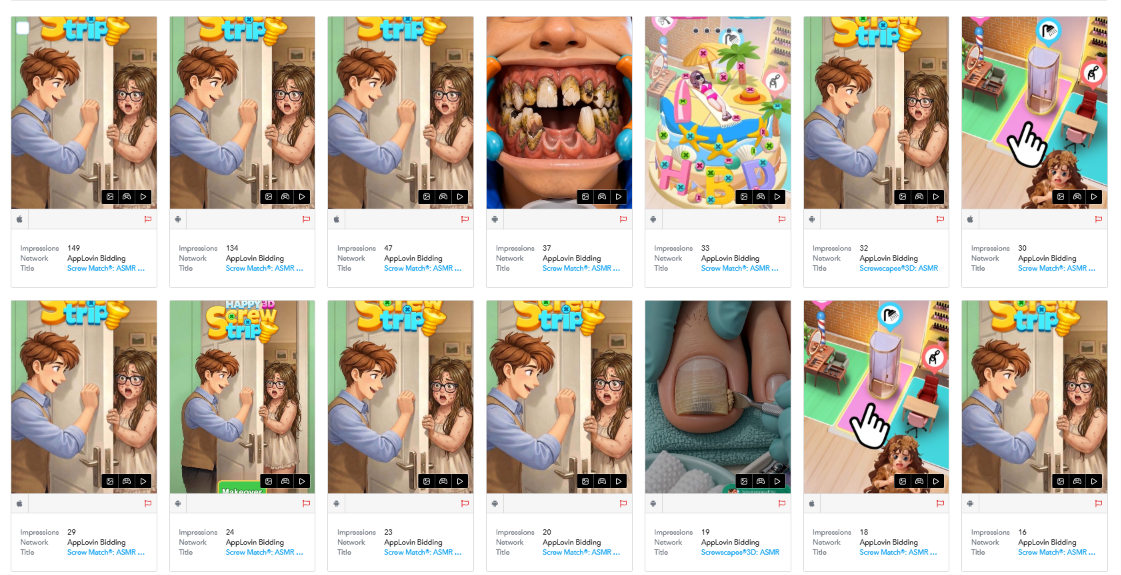
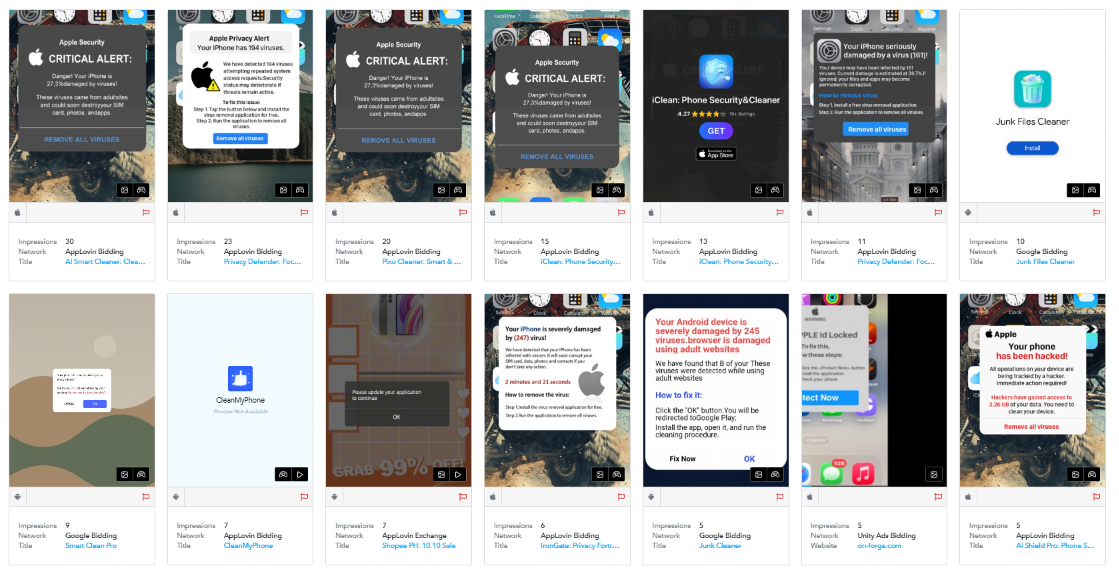
What’s worth noting is that this publisher cares about their ad quality a lot. They already have category blocks in place, and they ran several rounds of blocking specific advertisers, apps, etc. Conducting a thorough review of the ads being served, we found that 1.25% of all ads fall into the most problematic categories (including, apart from the two above, adult & nudity, animated adult, real-money gambling & betting, etc.).
And don’t think that players are not paying attention. According to last year’s study by Google AdMob and Deloitte, 52% of gamers say they would churn following repeated encounters with disruptive ad features (compared to 20% who churn in one encounter, on average).
With this in mind, do have a look at our blocklist in the section below. It’s completely free and you can easily have these blocks and prevent them from churning your users.
What can be done to improve the situation?
Organizations such as ASA, SRC and Ad Standards can and should do the work. They should set expectations and examples of what’s acceptable and what’s not. And make their findings public. But realistically, they don’t have the bandwidth to deal with millions of creatives running on billions of devices around the globe.
Instead.
- Apple and Google should take ownership. They should prevent gruesome, border-pornographic, low-value, AI-slop apps from being published in their stores in the first place. No app = no advertising. Terms of use of their platforms are somewhat tackling this, but the enforcement needs to be much more consistent.
- Ad networks should take ownership. Mediators too. Networks should have more rigorous processes, more checks in place, automatic and manual, if need be. They should do their best to prevent ads from ever showing. For those ads that are missed, they should make it as easy as possible for publishers to block them. Google, for example, by default allows only 500 apps to be blocked, which, if you haven’t been paying attention, is not nearly enough. Applovin and Moloco don’t even have this option in their dashboard, so unless you have a solid contact point there, say goodbye to your users.
At the end of the day, publishers and advertisers too need to take responsibility for the ads they're putting in front of users. We all know how competitive mobile advertising has become, and when inappropriate, misleading, or downright disgusting ads deliver results, it's hard to expect anyone to voluntarily stop running them while everyone else continues.
Someone has to take the first step. Publishers need to be more selective about the ads they allow in their games, advertisers need to rethink how far they're willing to go for performance, and the industry as a whole needs to stop treating user experience as collateral damage.