



Featured article

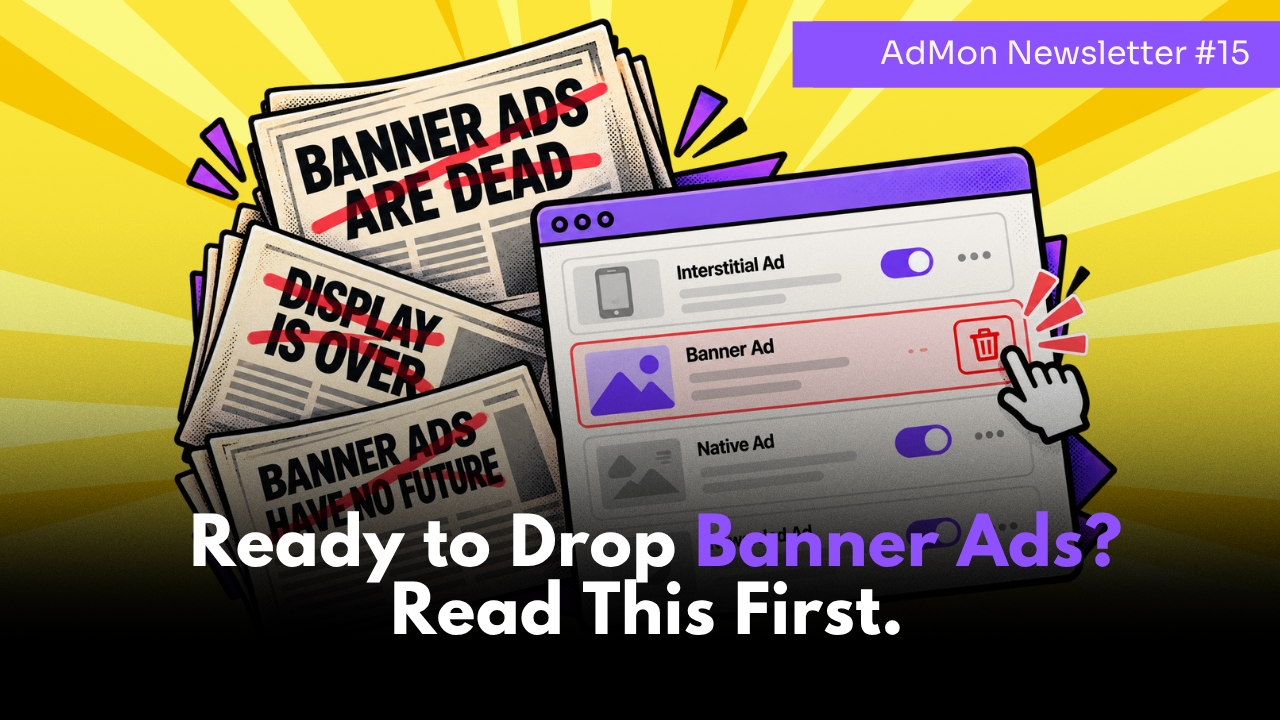
A few months ago, Zedge shared the results of a massive experiment where banners were removed completely for roughly half of 17.7 million users. For those unfamiliar with Zedge, it’s a Wallpapers & Ringtones app with more than 500,000,000 lifetime downloads according to AppMagic. What makes this case really interesting is that they shared a lot of data about the experiment. Kudos for that. The results: total ad impressions dropped by 38%, while LTV increased by 1%. Zedge’s conclusion was basically that banners are becoming obsolete. From the data they shared, I’m not convinced that we can make that generalization.
They aren’t the only ones making this claim. Over the past year, it’s become more and more common to hear that banners have lost their relevance. Clients have started asking me whether they should remove them. Banners have undeniably lost some of their glory, but I think there’s still plenty of gas left in the tank.
But let’s get back to Zedge’s case study. Their thesis is that banners cannibalize other formats: they absorb advertiser demand that could otherwise fill higher-value placements and distract users from higher-value actions. Remove banners, and both user experience and monetization improve.
Impression-Revenue Disconnect
After banners were removed, interstitial impressions increased 18%, rewarded 10%, native 16%, and MREC 6%.
An 18% increase in interstitial impressions, plus growth across three other formats, produced only a 1% lift in LTV. That makes me question how much “dead weight” banners really were. Were the other formats replacing substantial banner revenue, or were those additional impressions less valuable than they appear? Without revenue by format, we can’t see how much banner revenue was lost or what replaced it.
The net result favours removal for Zedge. But a small upside alongside substantially more interstitial impressions is scary. In a product more sensitive to interstitial pressure, the result could easily flip.
The Demand-Shift Paradox
Higher impressions alone don’t prove that advertiser demand shifted. But let’s assume for a moment that Zedge’s theory is correct.
If removing banners from half of the user base really changes advertiser demand across the whole app, how do you avoid contaminating the control group?
Reducing banner supply could change banner pricing or fill for users who still see banners. Demand for other formats could also change across both groups. If that happens, a 50% test is not necessarily a good estimate of what happens at 100% rollout.
So the article is effectively making two claims at once: that this is a clean user-level A/B test, and that the treatment changes the advertising marketplace around those users. If the second claim is true, the first becomes hard to defend.
What’s Hiding Inside the +1% LTV?
With 17.7M users, reporting only an average +1% lift is leaving a huge chunk of information unexplored. I would be very surprised if banners were negative for every type of user. A +1% average can hide a lot of very different outcomes underneath it. Finding those differences is probably more useful than deciding whether banners should exist for everyone or not.
Checking for a Pulse?
Banners have been around for years, and some of the best admon teams in the business are still using them. It’s possible they’re all leaving money on the table, but that would be a big, industry-wide blind spot.
However, the fact that some experienced admon people are vocal about banners being dead should make you at least curious about their removal.
I’ve run that test myself and got the opposite result — removing banners reduced overall LTV. The decline was present across every segment we analyzed.
To be clear, one test doesn’t disprove another. Removing banners seems to have been a good move for Zedge. But their test doesn’t show that the banner is dead. It just opens up a much more useful question: For which apps and which users are banners still the more profitable choice?
To give you an idea of how well banners can still perform, here are banner eCPMs from two apps and a game. All three come from high-value segments whose banner impressions generated between 3.8% and 5.6% of the app’s total ad revenue.
- App 1: $8.80
- App 2: $9.30
- Game 1: $12.50
These are banners earning eCPMs at levels usually reserved for full-screen ads.
I wouldn’t arrange the funeral just yet.


